Keywords are Dead. Long Live "Entities": How AI Understands Your Brand
 MultiLipi
•
Jan. 28, 2026
•
5 Min read
MultiLipi
•
Jan. 28, 2026
•
5 Min read
Modern CMOs and SEO managers are facing a jarring new reality: the fundamental nature of search is undergoing a radical transformation. Website traffic is plunging for many brands despite maintaining stable rankings, as traditional keyword-centric tactics no longer deliver the exponential growth they once did. In fact, recent industry analysis indicates that a staggering 96.5% of web content now receives zero organic traffic from Google. This is not a failure of content quality, but a shift in the "rules of the game." We have entered the era of answer engines and AI-driven search, where isolated keywords have lost their once-mighty power.
The shift began years ago with a mantra from Google: “Things, not strings.” This signaled a move from matching simple text strings to understanding the deep relationships between entities. In 2026, this shift reached a critical tipping point. If your marketing strategy still revolves primarily around chasing keyword rankings, you risk fading into obscurity. Today’s digital landscape is dominated by AI assistants and knowledge graphs that deliver synthesized answers directly to users, often bypassing the traditional list of links altogether. This guide explores why traditional keywords are dying and why Entities are the new cornerstone of Generative Engine Optimization (GEO).
The Fall of Keyword-Centric SEO
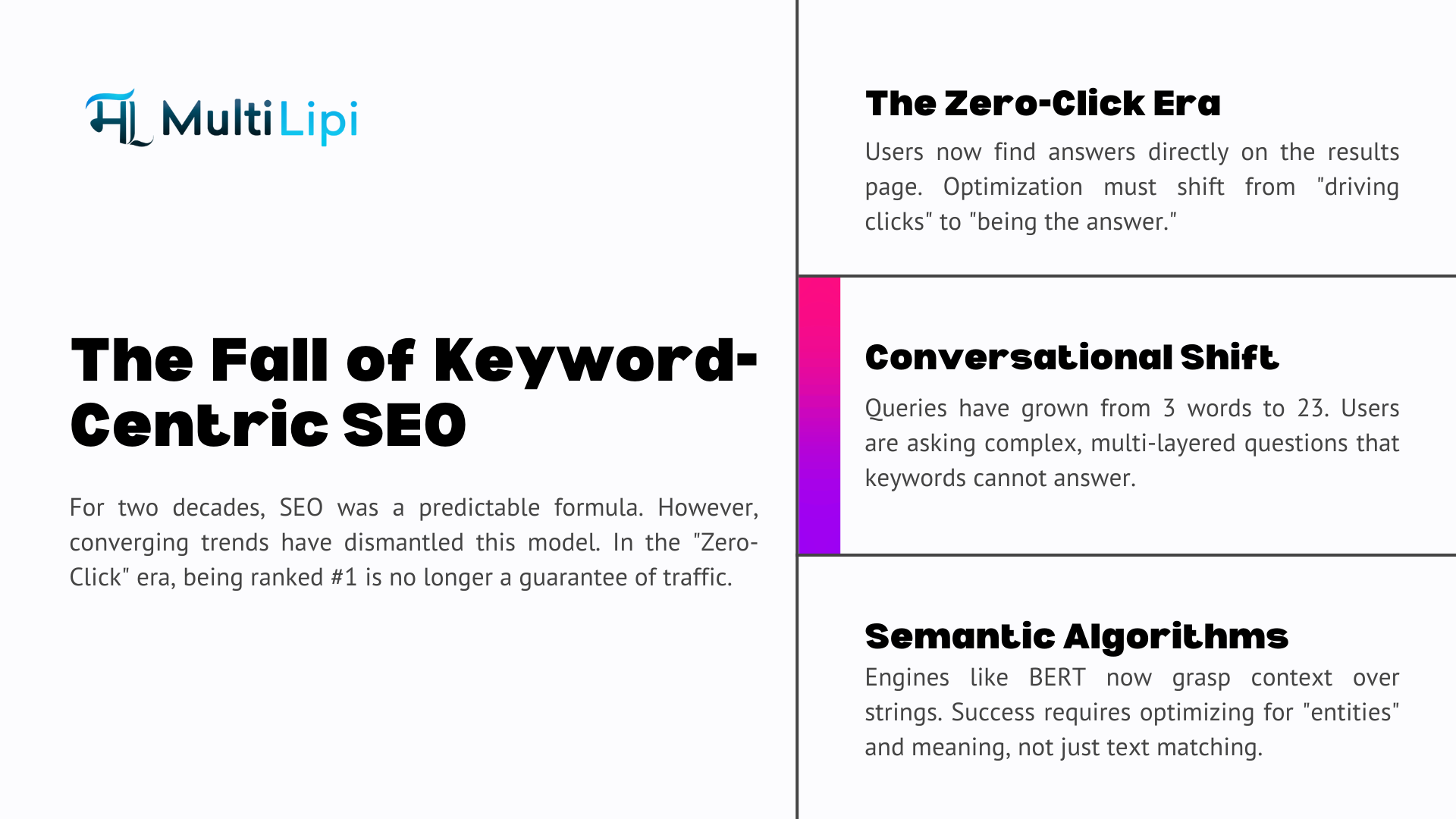
For two decades, SEO was a predictable formula: identify high-volume keywords, optimize your on-page text, and build backlinks to climb the "blue link" ladder. However, several converging technological and behavioral trends have dismantled this model.
The Rise of the Zero-Click Era
We are now firmly in the "Zero-Click" era. More than half of all Google searches end without a single click to a website because users find the information they need directly on the results page through featured snippets, Knowledge Panels, and AI-powered overviews. Data from [Elementor - 26 AI SEO Statistics for 2026] reveals that 65% of Google searches now result in zero clicks. This trend is even more pronounced on mobile devices, where zero-click rates can reach 77%. In this environment, being ranked #1 for a keyword is no longer a guarantee of traffic; you must now optimize to be the information source Google uses for its instant answers.
The Conversational Shift in Search Queries
The way users interact with search engines is becoming increasingly conversational. According to [Search Engine Journal - 5 Key Enterprise SEO And AI Trends For 2026], AI search queries now average 23 words in length, compared to the terse 3–5 word queries common in classic search. Users are no longer typing "best sneakers"; they are asking, "What are the most durable running shoes for someone training for their first marathon with a history of knee pain?" Traditional keyword-stuffing cannot answer these complex, multi-layered intents. AI models instead parse the semantic meaning of the entire question, seeking authoritative entities that provide a comprehensive solution.
The Evolution of Semantic Algorithms
Search engines have evolved from mere indexers of text into sophisticated context engines. Updates like Hummingbird, RankBrain, and BERT moved Google away from simple keyword matching toward a deep understanding of words in context. Today, search engines attempt to grasp what you are actually talking about rather than just identifying specific phrases. This is why brands must pivot toward MultiLipi - Forget SEO. Welcome to GEO (Generative Engine Optimization), a strategy built for this new semantic reality.
What are Entities? "Things, Not Strings"
To successfully pivot, marketers must understand that an Entity is a distinctly identifiable thing or concept a person, place, organization, or abstract idea that is independent of language or phrasing. While a keyword is just a string of letters, an entity is a specific node in a global knowledge graph.
The Knowledge Graph: Your Digital ID
Google’s Knowledge Graph is a massive database of billions of facts about entities and their relationships. As explained in [Google - Introducing the Knowledge Graph: things, not strings], this graph allows search engines to understand that "Jaguar" can refer to a car brand, an animal, or a professional sports team depending on the surrounding context. If your content clearly identifies the entities it discusses, it is far more likely to be featured in Knowledge Panels and AI summaries.
Why AI Prioritizes Entities Over Keywords
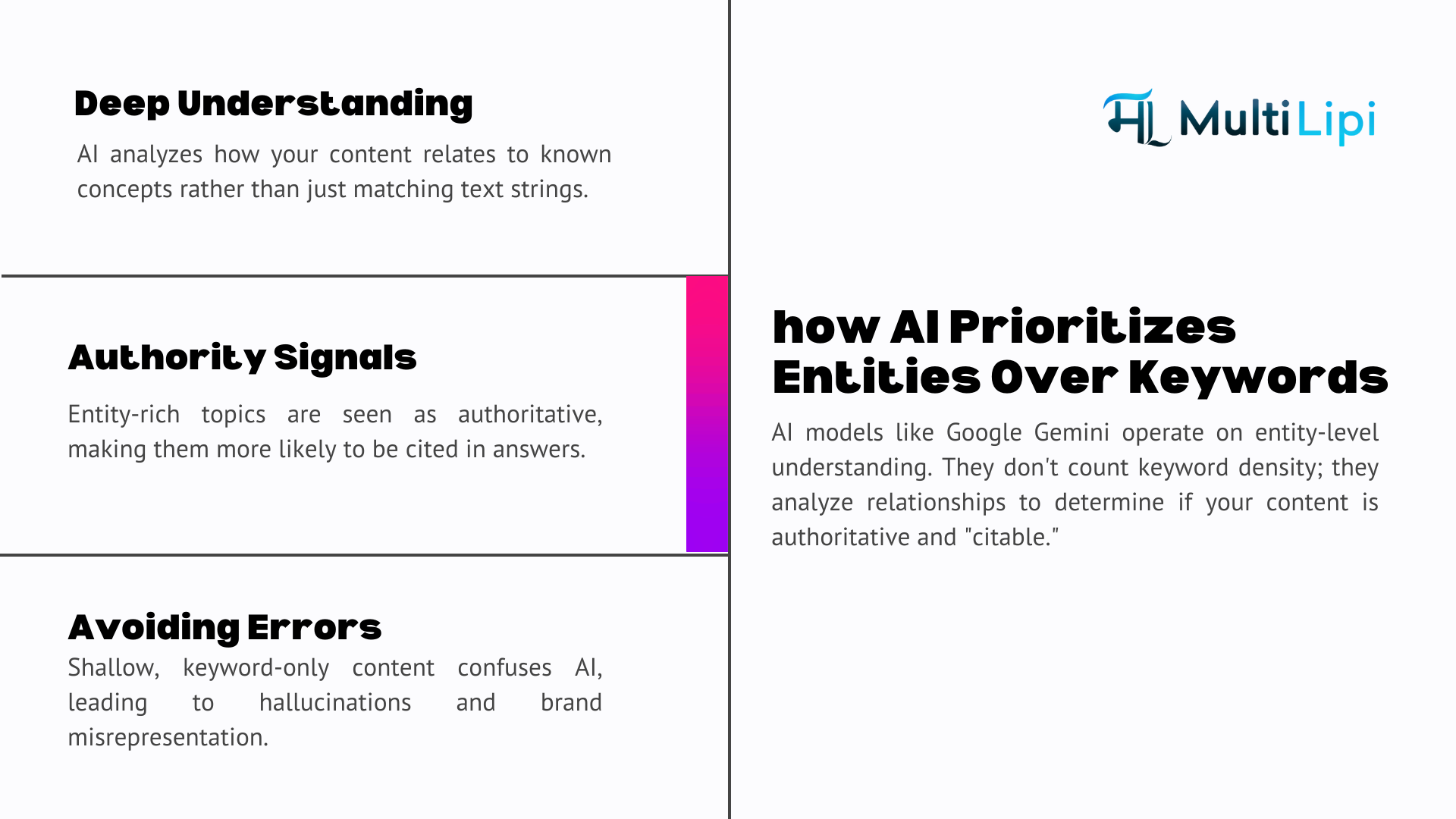
AI models like GPT-4 and Google Gemini operate on entity-level understanding. They don't count how many times you used a specific word; they analyze how your content relates to known concepts. If your website focuses on deep, entity-rich topics, AI finds it more authoritative and "citable." However, if your content is shallow and purely keyword-focused, AI may struggle to interpret your intent, leading to "hallucinations" or misrepresentation of your brand. This risk is a significant threat to global reputation, as detailed in MultiLipi - The Silent Killer: Why AI Hallucinates When It Reads Your Multilingual Site.
From Links to Citable Answers: The GEO Narrative
In the traditional SEO model, you were essentially competing against other web pages to climb a list of links. Your goal was to capture visibility on page one and hope for a click. In the new GEO paradigm, you are instead competing against the entire "knowledge graph" of an AI engine. The AI is looking for a single, synthesized answer to present to the user, and it will only cite the most authoritative and well-structured sources it finds.
This transition represents a shift in your primary goal: you are no longer just optimizing for clicks; you are optimizing for citations. Success in GEO is measured by how often AI models mention your brand and use your content to answer user queries. Research from [Search Engine Land - Google AI Overviews drive 61% drop in organic CTR] highlights that while traditional clicks are down, being featured as a cited source in an AI answer box can actually increase your brand's credibility and drive high-intent residual traffic. To achieve this level of visibility, brands need to move beyond simple translations and master MultiLipi - Cultural Nuance in SEO.
Multilingual Entities: Connecting the Global Knowledge Graph
For international brands, the most powerful aspect of entities is that they are language-agnostic. The entity for "apple (fruit)" is the same node in the knowledge graph whether a user searches for it in English, Spanish (manzana), or Hindi (सेब).
The Transfer of Global Knowledge
Advanced AI models like Google’s MUM (Multitask Unified Model) are now capable of transferring knowledge across languages. This means an AI could potentially answer a query in French using information it found on an English-language site. While this sounds beneficial, it poses a risk: the AI might provide the answer without ever directing the user to your localized site. To prevent this "knowledge cannibalization," you must establish your brand’s authority within each specific language market. This is why we have developed the MultiLipi - Multilingual Content Outreach Guide to help you build localized trust signals.
Establishing Regional Trust
AI models often exhibit a bias toward high-volume language sources like English. To overcome this, brands must build E-E-A-T (Experience, Expertise, Authoritativeness, Trustworthiness) in every target market. This involves earning local backlinks, appearing in regional news, and ensuring your technical foundations are flawless. Using the MultiLipi - Ultimate Hreflang Tag Guide is essential here to signal to search engines exactly which language version of your content is intended for which audience, preventing cross-language confusion.
The Implementation Playbook: Entity-First Optimization
To thrive in the age of GEO, your content strategy must evolve. Here is a roadmap for implementing an entity-first approach:
- Map Your Entity Ecosystem: Identify the core entities that define your brand—your products, your leadership, and your industry’s primary topics. Move from a list of keywords to a map of "things" you want to own.
- Provide Answer-First Content: AI and human readers both value speed. Structure your content so the most important answers are at the very top. As noted in [HubSpot - The Future of AI in Marketing], content that provides direct, concise value is 202% more likely to be featured in AI-driven responses.
- Implement Advanced Schema Markup: Schema is the language that machines use to understand your "strings." By using JSON-LD to explicitly define your brand, products, and FAQs, you provide AI with a "cheat sheet" it can use for citations. Learn how to do this correctly in our MultiLipi - Multilingual Schema Markup Guide.
- Audit Your AI Visibility: Traditional SEO audits are no longer enough. You must now perform "AI audits" to see how LLMs interpret your brand. You can begin this process by using the MultiLipi - Free SEO Audit Tool to identify gaps in your current technical and semantic structure.
- Focus on Information Gain: Don't just rehash existing content. AI models prioritize content that adds new, unique data points to their knowledge graphs. For a detailed comparison of how this differs from traditional tactics, see MultiLipi - Alternatives and Comparisons.
Building Brand Authority as an Entity
Ultimately, your goal is to make your brand itself a trusted entity in the global knowledge graph. This requires more than just good SEO; it requires digital PR and consistent authority building. AI models frequently consult authoritative databases like Wikidata, which currently contains over 100 million entities in 300+ languages. Ensuring your brand is correctly represented in these databases is a crucial step in future-proofing your visibility.
According to the [McKinsey - The state of AI in 2025: Agents, innovation, and transformation], companies that proactively manage their AI visibility and brand sentiment across communities like LinkedIn and Reddit are seeing higher engagement in AI-mediated searches. To maintain this level of authority across multiple markets, you must accurately track the volume and health of your localized content. Start by using the MultiLipi - Free Word Count Tool to plan your global expansion.
Conclusion: Mastering the New Search Currency
Keywords may be "dead" as a standalone strategy, but they have evolved into something far more powerful: Entities. By shifting your focus from "strings" to "things," you align your marketing with the fundamental logic of modern search engines and AI models. This evolution is not a temporary trend; it is the new standard for 2026 and beyond.
Case Study: Global Growth through Entity Authority
MultiLipi’s impact is best demonstrated through our work with Hotel Continentale, a boutique hotel in Italy. Initially, their digital presence was confined to a single-language Italian site, leading to high bounce rates for international visitors who couldn't find the information they needed. By implementing a comprehensive GEO and Hreflang strategy across 8 languages, the hotel established itself as an authoritative entity in multiple markets. This resulted in a 120% increase in organic traffic from Germany and France and a 35% surge in direct international bookings. The site transformed from a static page into a citable, trusted source that AI search engines frequently recommended to travelers. These results highlight that when you optimize for context and entities, you aren't just gaining traffic, you are building a global brand.
Start Your Multilingual Journey Today
The future of search is no longer about just being found; it’s about being understood.
- MultiLipi - Free Word Count Tool: Calculate your translation volume accurately.
- MultiLipi - Free SEO Audit Tool: Detects gaps in your current multilingual SEO strategy.
- MultiLipi - Free Hreflang tag checker Tool: scans your page and identify existing tags, and validate them with better suggestions
- MultiLipi - Free LLMs.txt file Tool: Scans your webpage to extract relevant information and creating a structured LLMs.txt file
Ready to dominate the era of answer engines? Sign up or log in to your MultiLipi - Dashboard Login to begin your multilingual expansion today.
Comments